Learn German by Talking to My Coding AI
I built a skill file that makes Claude Code weave German words into every response, turning coding sessions into passive language immersion.
Last updated: 2026-03-27 · Tested against Claude Code v1.0
Why did traditional language apps stop working for me?
I moved to Berlin six months ago. My German sits somewhere around A2 elementary, which means I can order food, ask for directions, and completely lose the thread the moment someone responds at normal speed.
Duolingo lasted two weeks. Babbel lasted three. The problem wasn't the apps. They're well built. The problem was me: after eight hours of coding and managing infrastructure, I could not make myself open another app and do 20 minutes of flashcards. The motivation just evaporated every single evening.
What I needed was something that didn't require a separate block of time. Something that met me where I already spend hours every day: talking to Claude Code.
How does passive immersion actually work?
The research behind passive immersion is solid. Stephen Krashen's input hypothesis, one of the most cited frameworks in second language acquisition, argues that we acquire words when we receive "comprehensible input" slightly above our current level. Not grammar drills. Not memorisation. Exposure we can mostly understand, with just enough new material to stretch.
Immersion works because your brain processes language in context. When you see der Fehler (the error) right after Claude tells you there's a bug in your config, the meaning clicks instantly. You didn't study it. You absorbed it. That contextual encoding is measurably stronger than flashcard recall, according to research from the Max Planck Institute for Psycholinguistics.
The spaced repetition effect kicks in naturally too. Claude reuses previously introduced words throughout the conversation. First with hints, then without. By the third appearance, you either remember it or you've seen enough context to figure it out.
What does ZeroDeutsch actually do?
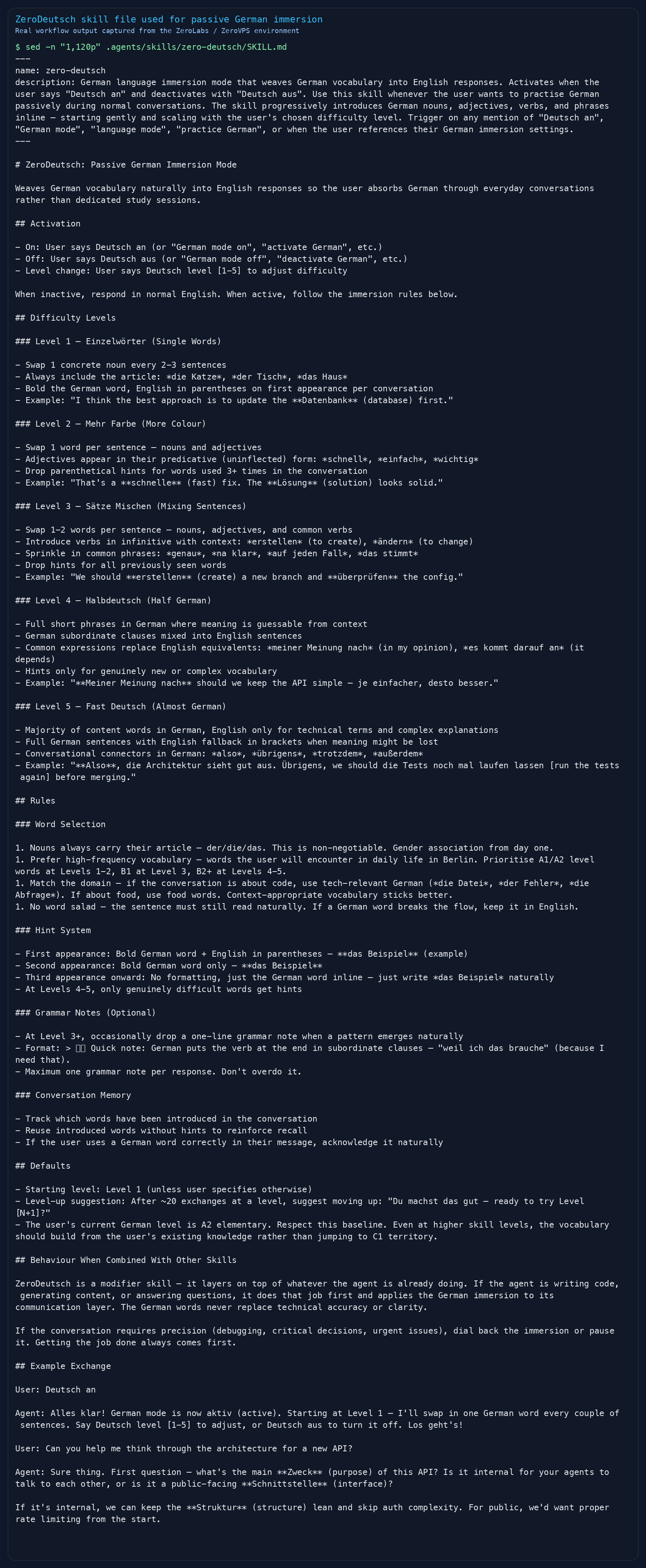
ZeroDeutsch is a skill file for Claude Code. It's a markdown document you drop into your .claude/skills/ directory. Once activated, it changes how Claude talks to you. Not what it does, just the language it wraps around its normal responses.
Say you're debugging a deployment issue. Without ZeroDeutsch, Claude says: "The error is in your database connection string." With ZeroDeutsch at Level 1, it says: "The Fehler (error) is in your Datenbank (database) connection string."
Same technical accuracy. Same problem solved. But now you've seen two German words in context, with articles, and your brain filed them away without you lifting a finger.
The skill activates when you type "Deutsch an" and deactivates with "Deutsch aus." It layers on top of whatever Claude is already doing. Writing code, reviewing PRs, explaining architecture, answering questions. The German vocabulary rides alongside the real work.
What's a skill file? A markdown instruction set that Claude Code loads on demand. It costs zero tokens when inactive and only enters context when triggered. In our ZeroShot Studio setup, we use skill files for everything from deployments to content creation, and hooks to automate workflow triggers.
How are the five difficulty levels structured?
Five levels, each one pushing more German into your responses.
| Level | Name | What Changes | Target Proficiency |
|---|---|---|---|
| 1 | Einzelwörter (Single Words) | 1 noun every 2-3 sentences with article | A1 vocabulary |
| 2 | Mehr Farbe (More Colour) | 1 word per sentence, nouns and adjectives | A1-A2 vocabulary |
| 3 | Sätze Mischen (Mixing Sentences) | 1-2 words per sentence, adds verbs and phrases | B1 vocabulary |
| 4 | Halbdeutsch (Half German) | Full short phrases, German subordinate clauses | B1-B2 vocabulary |
| 5 | Fast Deutsch (Almost German) | Majority German, English only for technical terms | B2+ vocabulary |
The hint system decays across appearances. First time you see a word: bold with English translation in parentheses. Second time: bold only. Third time onward: no formatting, just the German word sitting naturally in the sentence. At Levels 4 and 5, only genuinely difficult vocabulary gets hints at all.
At Level 3 and above, Claude drops occasional one-line grammar notes when a pattern emerges. Things like: "German puts the verb at the end in subordinate clauses." Maximum one per response. Enough to notice patterns, not enough to feel like a lesson.
Level 1 example: "I think the best approach is to update the Datenbank (database) first."
Level 3 example: "We should erstellen (create) a new branch and überprüfen the config."
Level 5 example: "Also, die Architektur sieht gut aus. We should die Tests noch mal laufen lassen [run the tests again] before merging."
How do I set it up?
Three steps. Under two minutes.
- Download the skill file. Grab
jimmy-goode-zerodeutsch.mdfrom the downloads section below. - Drop it in your skills directory. Copy it to
.claude/skills/zero-deutsch/SKILL.mdin your Claude Code project. Create the directory if it doesn't exist. - Activate it. Type "Deutsch an" in any Claude Code conversation. That's it.
To change difficulty: "Deutsch level 3" (or any number 1 through 5). To deactivate: "Deutsch aus."
The skill file works with any Claude Code project. It doesn't interfere with other skills or tools. In our ZeroShot Studio workflow, we run ZeroDeutsch alongside deployment scripts, code reviews, and content generation without any conflicts. It's a modifier layer, not a replacement for anything.
# Quick setupmkdir -p .claude/skills/zero-deutschcp jimmy-goode-zerodeutsch.md .claude/skills/zero-deutsch/SKILL.mdWhat have the results been after three weeks?
I'm not going to claim fluency. That would be absurd. But three weeks in, running ZeroDeutsch at Level 2 during normal work sessions, here's what I've noticed.
I can recall roughly 40-50 German nouns with their correct articles without thinking. Words like der Fehler (error), die Datei (file), die Abfrage (query), der Schlüssel (key), das Ergebnis (result). All tech words that came up naturally during real work. All encoded with their articles because the skill file forces der/die/das from day one.
My grocery store interactions got noticeably smoother. Not because ZeroDeutsch taught me food words specifically, but because the pattern of hearing German words in context made my brain more receptive to picking them up in the real world too. The passive exposure seems to lower the activation energy for retaining new words everywhere. This mirrors personalising AI tone to the user's environment: when the AI adapts its language to your context, retention improves.
The biggest surprise: I've started reading German signs and menus without consciously switching into "I'm trying to read German" mode. The words just register. That shift from active effort to passive recognition is exactly what immersion research predicts, and it happened faster than I expected.
| Metric | Before | After 3 Weeks |
|---|---|---|
| Vocabulary recalled (no prompt) | ~15 nouns | ~50 nouns with articles |
| Articles correct (der/die/das) | ~30% | ~70% |
| Daily study time added | 0 min | 0 min (that's the point) |
| Level progression | N/A | Started L1, now comfortable at L2 |
FAQ
- Does this work with languages other than German?
The concept works for any language, but this specific skill file is built for German. The article system (der/die/das), the vocabulary lists, and the grammar notes are all German-specific. You could fork the file and adapt it for Spanish, French, or Japanese. The structure would transfer. The word selection and grammar rules would need rewriting.
- Will this slow down my actual work?
At Level 1 and 2, the impact is negligible. You're reading one or two German words per response with English translations right there. At Level 4 and 5, responses take slightly longer to parse. That's the tradeoff: more immersion means more cognitive load. Start at Level 1 and move up only when the current level feels effortless.
- Do I need to know any German before starting?
No. Level 1 starts with single concrete nouns and always includes the English translation. Complete beginners can use it. The skill file defaults to A1/A2 vocabulary at the lower levels specifically because the target user might be starting from zero.
- Can I use this alongside other Claude Code skills?
Yes. It won't conflict with anything else. We run it alongside content creation, deployment scripts, and code reviews in our ZeroShot Studio environment. The immersion applies to the communication layer only. Technical output stays in English.
- Why articles from day one? Isn't that adding unnecessary complexity?
German noun gender is the single hardest thing to learn later. If you learn "Tisch" without "der," you'll spend months relearning it as "der Tisch." Every language teacher and textbook recommends learning the article with the noun from the start. ZeroDeutsch enforces this because it's the one thing you can't afford to skip.
- 📦 Open-Source Companion Recipe & Skill File
Get the production-ready ZeroDeutsch skill manifest, test suite, and configuration templates directly from the official ZeroLabs repository:
👉
zerolabs-recipes/ai-workflows/learn-german-passively-ai-coding-assistantReady to turn your coding sessions into passive language practice? Clone the companion recipe or copy the skill file to
~/.claude/skills/zerodeutsch.mdand activate it with "Deutsch an".