8 examples of Gemini 4 Argon in action
Turn months of complex work into minutes of execution with our smartest AI model yet. Learn practical implementation patterns and production workflows.
What was announced
Google Gemini Blog released an official announcement regarding 8 examples of Gemini 4 Argon in action on November 06, 2026.
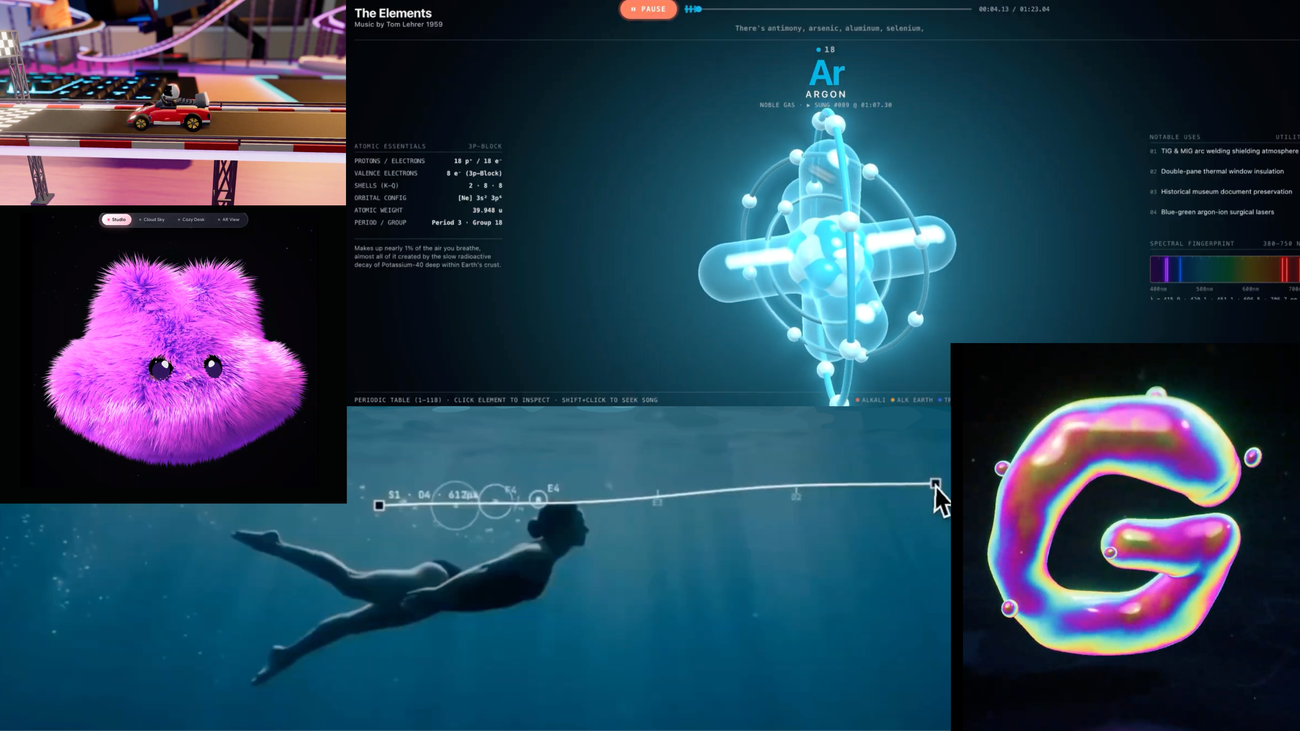
Turn months of complex work into minutes of execution with our smartest AI model yet. Our newest model, Gemini 4 Argon , was built to solve your hardest problems. By tackling complex, real-world tasks and taking on high-stakes work that used to require months of manual effort, it's fundamentally changing the way we work and build at Google - ...
Key technical developments and highlights detailed in the release include:
- Handling complex tasks: Using advanced reasoning and multimodal capabilities, Gemini 4 Argon excels in deep comprehension and long-horizon workflows. From a short prompt and with zero assets or libraries, Argon wrote 5,000 lines of math to render a 3D sunlit library from scratch - and then made a...
- Making interactive tools and playable 3D games: Googlers have used Argon to prototype complex 3D visualizations, high-fidelity games, and interactive animations. When prompted to build an app to overlay shapes across videos, Gemini 4 Argon in the Gemini app generated a custom audiovisual tool that traces musical scale...
- Optimizing workflows: Argon combines frontier reasoning, deep visual perception, expanded knowledge, and stronger writing capabilities to help with high-stakes professional workflows. Given a custom slides template and more than 80,000 raw files from NASA - including weather logs and engineering,...
- Building engaging visuals: Gemini 4 Argon is especially strong when work requires visual understanding. When prompted to make dense academic chapters come alive, Argon used Nano Banana and Veo to transform the scientific concepts in a PDF into an illustrated animation of key moments in the Gemini app....
- Generating lifelike textures: Argon brings a deeper understanding of real-time 3D rendering, lighting and shading, and interactive physics simulation. This allows Argon in Antigravity to code a custom “fur engine” with studio-grade hair dynamics, generating visually rich fur that grows and moves as a...
Why this matters for technical teams
Updates across foundation models and developer ecosystems directly affect platform baselines, integration ergonomics, and operational trade-offs.
- Developer ergonomics & scaffolding: New features alter baseline expectations and test whether custom agent glue code can be simplified.
- Operational trade-offs: Upgrades to foundation models redefine reasoning ceilings, token latency, and autonomous tool calling reliability across agent architectures.
- Evaluation priorities: Builders should benchmark this release against their domain-specific evaluation harnesses to measure real-world task accuracy and latency.
Source documentation and primary references: Google Gemini Blog.
ZeroLabs Take
Real architectural progress matters far more than synthetic benchmark vanity scores. While Google Gemini Blog's release notes for 8 examples of Gemini 4 Argon in action showcase impressive capability figures, builders care about three concrete realities: function-calling determinism, end-to-end token latency, and predictable operational cost. If the updates documented in this release deliver verifiable improvements in multi-step task execution without degrading instruction following, it represents genuine engineering value. We welcome capability jumps that reduce brittle agent glue code, but recommend evaluating them on your own task distributions before refactoring production systems.
What ZeroLabs is watching next
- Community stress tests: Tracking independent evaluations of instruction following, needle-in-a-haystack retrieval, and complex coding harnesses.
- Tool-calling determinism: Measuring structured output schema compliance under load across complex agent swarms.
- Frontier competition: Watching how Anthropic, Google, and OpenAI adjust their matching latency and pricing tiers in response.
FAQ
- What was officially announced?
Google Gemini Blog published details on 8 examples of Gemini 4 Argon in action, focusing on frontier model architecture and developer capabilities.
- How does this affect existing developers and users?
Builders should benchmark this release against their domain-specific evaluation harnesses to measure real-world task accuracy and latency.
- Where can I access the complete release details?
The full announcement and documentation are available directly from Google Gemini Blog.