Persistent Memory for Autonomous Agents
Design tiered agent memory with SQLite indexes, vector stores, and state machines so long-running agents remember work without dumping the whole context.
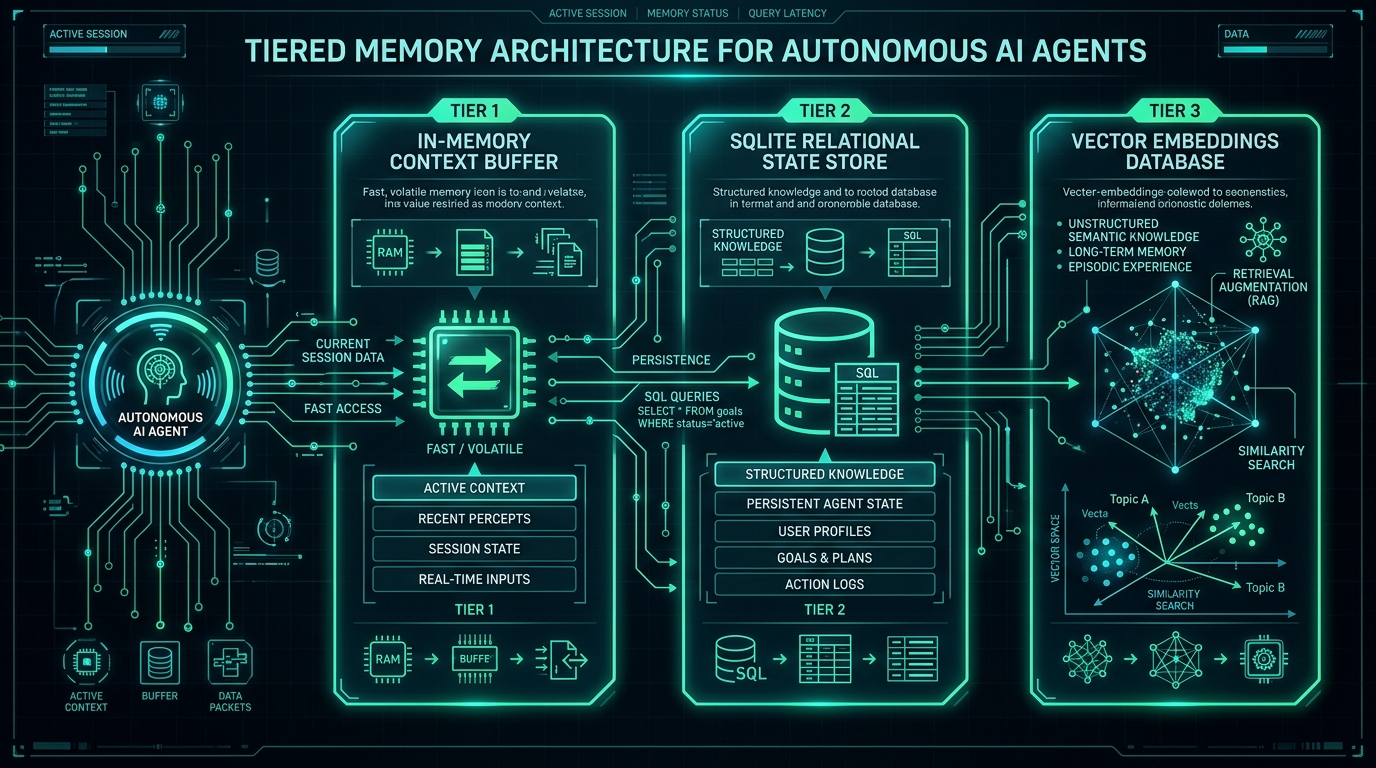
What are the limitations of pure in-context agent memory?
As autonomous agents execute complex multi-step workflows, their conversational context grows rapidly. Relying solely on in-context message history causes three major issues:
- Context Window Degeneration: Large contexts dilute attention, causing models to ignore earlier instructions or fail tool validations.
- High Token Costs: Resending hundreds of thousands of tokens on every single tool step multiplies inference expenses exponentially.
- Session Fragility: If the process crashes or reaches a rate limit, all unpersisted state and progress are lost permanently.
flowchart LR
    A[Agent Runtime] -->|Active Turn| B[Working Context Buffer]
    A -->|Structured Events & Tasks| C[(SQLite State Store)]
    A -->|Past Decisions & Documents| D[(Vector Memory Store)]
    C -->|Hydrate State on Reboot| A
    D -->|Semantic Recall| B
How does the 3-tier memory architecture work?
Production agent systems separate memory into three distinct tiers based on latency, query style, and retention requirements:
| Tier | Technology | Purpose | Query Method |
|---|---|---|---|
| Tier 1: Working Memory | In-Memory / Context Buffer | Current turn instructions, immediate tool output | Direct prompt injection |
| Tier 2: Episodic / Relational State | SQLite Database | Task queues, tool execution logs, user preferences | Structured SQL (WHERE, ORDER BY) |
| Tier 3: Semantic Long-Term Memory | Vector Store (Chroma/pgvector) | Historical code patterns, documentation, past resolutions | Cosine similarity embedding search |
How do you implement SQLite state storage for agents?
SQLite provides a lightweight, zero-configuration relational database ideal for local and self-hosted agents. It allows agents to maintain structured records of tasks, decisions, and system logs across reboots.
Here is a lightweight Python implementation for managing persistent agent state:
import sqlite3import jsonfrom datetime import datetime, timezoneclass AgentStateStore: def __init__(self, db_path: str = 'agent_state.db'): self.conn = sqlite3.connect(db_path) self._init_schema() def _init_schema(self): with self.conn: self.conn.execute(''' CREATE TABLE IF NOT EXISTS session_state ( session_id TEXT PRIMARY KEY, current_task TEXT, variables_json TEXT, updated_at TEXT ); ''') self.conn.execute(''' CREATE TABLE IF NOT EXISTS task_log ( id INTEGER PRIMARY KEY AUTOINCREMENT, session_id TEXT, step_index INTEGER, action TEXT, result TEXT, timestamp TEXT ); ''') def save_state(self, session_id: str, current_task: str, variables: dict): now = datetime.now(timezone.utc).isoformat() with self.conn: self.conn.execute(''' INSERT INTO session_state (session_id, current_task, variables_json, updated_at) VALUES (?, ?, ?, ?) ON CONFLICT(session_id) DO UPDATE SET current_task = excluded.current_task, variables_json = excluded.variables_json, updated_at = excluded.updated_at ''', (session_id, current_task, json.dumps(variables), now)) def record_step(self, session_id: str, step_index: int, action: str, result: str): now = datetime.now(timezone.utc).isoformat() with self.conn: self.conn.execute(''' INSERT INTO task_log (session_id, step_index, action, result, timestamp) VALUES (?, ?, ?, ?, ?) ''', (session_id, step_index, action, result, now))When should you pair relational tables with vector embeddings?
Relational tables excel at deterministic queries (e.g. 'Show all failed tasks from today'), but struggle with semantic questions (e.g. 'How did we resolve that authentication error last month?').
By embedding task summaries and storing vectors alongside the SQLite task ID, the agent can perform hybrid retrieval:
- Search semantic memory using vector cosine similarity to locate the top 3 relevant past experiences.
- Load the full execution trace from SQLite using the associated task ID.
- Inject the synthesized solution directly into Tier 1 working memory.
This approach keeps prompt sizes small while providing full access to months of operational experience.
FAQ
- Why use SQLite instead of a full PostgreSQL server for agent memory?
SQLite requires no separate background server process, has zero network latency, and stores everything in a single portable file, making it ideal for local and single-node agent instances.
- How do you prevent agent databases from growing indefinitely?
Implement an automated retention policy that purges detailed tool traces older than 30 days while retaining high-level decision summaries and vector embeddings permanently.
- Can multiple agents share a single SQLite memory file?
SQLite supports concurrent readers, but multiple concurrent writers should use Write-Ahead Logging (
PRAGMA journal_mode=WAL;) or route state changes through a central supervisor process to prevent database locks.